| Indianvisit provides complete accommodation information for the culture of the Indian state of Kerala, list of Festivals in Kerala, and guide to Festivals of Kerala. |
Onam is celebrated in Kerala when the August monsoon rains give way to the pleasant warmth of autumn. Onam is the celebration of the return of Mahabali, the once and future king. This king ruled "when all men were equal, when no one was poor, when there was neither theft nor dread of thieves".
Vishu falls on the first of Medam (March-April), which is the Malayali New Year's Day. Since it is considered propitious to view good things on this day for year round good fortune, Vishu morning is an important time in Kerala.
The most spectacular festival of Kerala is Thrissur Pooram. Sakthan Thampuran, the Maharaja of erstwhile Kochi state, introduced this festival. Celebrated in Medom (April-May) the festival parades the fulgent faces of Kerala culture.
With every passing year Tthrissur Pooram, the temple festival, attracts large masses of devotees and spectators to Kerala.
For centuries, Sabarimala in Pathanamthitta has been a major pilgrim centre in Kerala attracting lakhs of devotees from all over India, more so from southern States. The presiding deity is Lord Ayyappa known as Dharma Sastha, a considered symbol of unity between Vaishnavites and Saivites.
On the great waterways of Kerala, fierce Vallom Kallies (boat races) and water carnivals erupt every year in a dramatic spectacle and hold tens of thousands of people spell-bound, cheering the action, laying bets, goading the boatmen to row faster.
Easter is the oldest Christian festival, as old as Christianity itself. The central tenet of Christianity is not the birth of Jesus, but his resurrection. Easter is derived from this paschal mystery and from the events of Good Friday. TheyyamTheyyam is one of the popular festivals of Kerala. It is the worship of the deity; on the other hand, the dancer is also the deity. Theyyam celebrates primarily the Mother Goddess. Animals, serpents, and trees also figure in worship.
|
|||

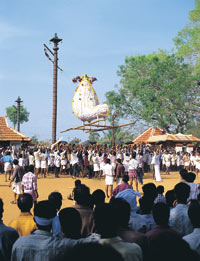 The Indian state of Kerala is renowned for its rich cultural heritage. Be it family reunions, dances, music and large-scale feasts mark the festivals in Kerala. Malayalis celebrate one festival irrespective of caste and creed: Onam. There are a few other festivals that are important like Thiruvathira, Vishu and Sabarimalai pilgrimage. There are also many local festivals in Kerala and every temple and church has its own annual festival.