|
Travel tips
- Woolens are essential in January-February when the temperature could drop to 5 degrees C. For other months, cottons of light tropical are comfortable. The rainy season is from July to September, which should be avoided as it may cause inconvenience
- The tourists require a valid passport and an appropriate entry, transit or tourist visa. The visa can be obtained from an Indian Mission abroad.
- Taxis, buses and auto-rickshaws are available at the airport to take you to the town. Bus charges are fixed. A prepaid taxi/auto service is available for all passengers for which the tourists can contact the Pre-Paid Taxi/Auto booth on arrival.
- Guides, waiters and taxi drivers, where service is not included, will expect around 10% of the total bill as a tip. Porters and bellboys will expect up to INR 50.00.
- You can bring with you any amount of foreign currency, travelers' cheques, etc., and take out the equivalent amount in return. However, if you are carrying more than US$2,500 (or equivalent) you should declare it on arrival, on the Currency Declaration Form (CDF), to be attested by the Customs Officer. No Indian currency can be brought into or taken out of the country. When remitting money to India, indicate the bank, branch and full address
- In India, the unit of currency is the Rupee (Re) divided into 100 paise (P). Change money with authorized moneychangers only at the airport, most of the banks, hotels and certain large shops.
- Rupees Three Hundred (Rs. 150 in the case of Afghanistan, Bangladesh, Bhutan, Burma, the Maldives, Nepal, Sri Lanka and Pakistan) is payable separately at the time of departure.
- The Central Bank in Ashok Hotel and State Bank of India at the Airport are open round the clock. Banks in residential areas generally observe the weekly holiday of that particular area. Credit Cards - American Express, Masters Charge Visa and Diners Club Credit Cards are generally accepted by large establishments, including hotels, shops and at airports.
- You can rent a chauffeur-driven car or join a conducted tour that is probably the best way to explore the maximum in minimum possible time.
- English speaking guides approved by the Govt. of India are available and can be hired from all important places of interest. They also assist in hiring guides able to speak other foreign languages.
- The Indian Standard Time (IST) for India is calculated from Allahabad and is common for all cities in the country. It is 5 hours and 30 minutes ahead of London, 4 hours and 30 minutes ahead of Paris, about 10 hours 30 minutes behind New York, 3 hours and 30 minutes behind Tokyo and 4 hours and 30 minutes behind Sydney.
- Delhi has an unlimited choice of non-vegetarian and vegetarian cuisines. You will find excellent restaurants and palatable Indian, Chinese, Continental and other cuisines served by them. Liquor is freely available in wine shops. It is also served in bars and restaurants in all major hotels.
- It's preferable to buy goods only from the established shops, showrooms and official Indian government outlets. Do visit the local bazaars, however, for interesting bargains.
Smoking is banned in public places, public transport and government offices, inside cinema halls and theatres located in the state of Delhi. In several other places boards prominently display the ban on smoking. Most hotels and restaurants have separate smoking zones.
Delhi observes dry days on most national and even some local holidays other than the 1st and 7th of every month. Various brands of imported liquor are now available in the market as well as the outlets run by the Delhi Tourism and Delhi Industrial Corporation. All big hotels and several restaurants serve liquor irrespective of dry days and holidays.
- Mosquitoes are common in summer and malaria and other water borne diseases can affect those who are not careful about the drinking water. Thus, it is advisable to carry mosquito repellent creams and other such devices that can keep this insect at bay.
- Instead of purchasing water from the local vendors or roadside sellers near bus stand and railway station; it is advisable that you buy mineral water from a proper outlet or a standard shop. This would also avoid the risk of any other disease.
Climatic conditions in Delhi
Delhi has a tropical steppe climate. The general prevalence of Continental air leads to relatively dry conditions with extremely hot summers.
- Monthly temperatures range from 14.3'C in January (minimum 3'C) to 34.5'C in June (maximum 47'C). The annual mean temperature is 25.3'C (WMO, 1971).
- The main seasonal climatic influence is the monsoon, typically from June to October.
- The annual rainfall total is 71.5 mm. Maximum rainfall occurs in July (211. mm). The heavy rains of the monsoon act as a "scrubber".
- North-westerly winds usually prevail; however, in June and July south-easterly predominate. Wind speeds are typically higher in the summer and monsoon periods; in winter, calms are frequent (20 per cent of the time)
The best seasons to visit Delhi are winter and spring.
Precautions
Delhi is a land locked city. Owing to the distance from the sea Delhi has an extreme type of continental climate. The summers in Delhi are very hot and winters very cold. The temperature range varies from 45 degrees in summers to 4 degrees in winters. The winters are distinct by mist and fog in the mornings and often sun is barely visible in the afternoons. The cold wave from the Himalayan region makes winters very chilly. In summers the heat wave is immense and adequate precaution has to be taken before going out in the hot summer afternoons.
Don't miss!
Delhi being the capital of India is a modern city with a historic past. A Tourist guide in Delhi will be incomplete without the mention of the Mughal monuments, the modern malls, the traditional arts, crafts, the trendy fashion shows, skyscrapers, parks and gardens - Delhi is a city that combines the historic and the modern in its own unique way.
Some of the tourist attractions of Delhi are:
Rashtrapati Bhawan: The elegant building and the residence of the president is situated on Raisina Hill in the center of Delhi, overlooking the green lawns around India Gate. This mansion is worth seeing, for its architectural beauty and historic significance. To add to its attraction, the beautiful Mughal Gardens of Rashtrapati Bhawan are open to the public in spring
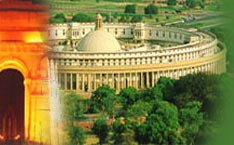
Parliament House: this elegant building, located in central Delhi is worth a visit, with its wide pillared walkways and large halls.
India Gate: Situated on Rajpath, in the center of Delhi, this 42-meter high arch was designed by Edwin Lutyens, in memory of the Indian soldiers who sacrificed their lives during the First World War the Amar Jawan Jyoti, an eternal flame, burns in memory of the Unknown Soldier, beneath the shelter of the arch. It is surrounded by green lawns, fountains and water bodies - an evergreen picnic spot in the heart of central Delhi.
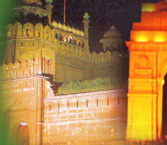
Red Fort: built during the Mughal emperor Shah Jahan's reign, this majestic building made of red sandstone is the location from where the Prime Minister of India addresses the nation every Independence Day. The Diwan-e-khas, and Diwan-e-am, the weaponry museum and the sound and light show are all worth seeing at the Red Fort.
Qutab Minar: this 72.5 m high pillar is a symbol of the Delhi Sultanate Built during the reign of Sultan Qutub-ud-din Aibak in 1199 A.D. the ruins of Kila Ri Pithora, the fort of Prithviraj Chauhan, and an amazing iron pillar from Gupta times which has not yet rusted can be seen near it.
Humayun's Tomb: Built by Humayun's wife, Hamida Begum, in 1556, after Humayun's death, this elegantly proportioned tomb, set on a platform amidst a garden, is believed to have influenced the design of the Taj Mahal.
Bahai Temple: it is commonly known as the Lotus Temple because the white marble structure is built to in the shape of a lotus, set amidst, lakes and green lawns it is a serene house of meditation, within which there are no idols and total silence prevails, so all can meditate in complete peace.
Jama Masjid: Built during the reign of the Mughal Emperor Shah Jahan, jama masjid is one of the largest mosques in India. Its large courtyard, onion domes and central tank are built of red sandstone and white marble in the Indo-Islamic style
To know more about tourist guide in Delhi and the other parts of India visit www.touristplacesinindia.com
|